
When Printable Hydrographic Film Beats Decals, Wraps, or UV Printing
Jun 23rd 2026
Decals, wraps, and UV printing all have their place. But when you need graphics to conform to complex 3D geometry, cover hard-to-wrap contours, or deliver a uniform look across edges and recesses, printable hydrographic film can be the better production solution.
This post breaks down practical industrial use cases where printable water transfer film outperforms other decoration methods, plus how to choose the right process for the part.
Why hydrographics can win in industrial production
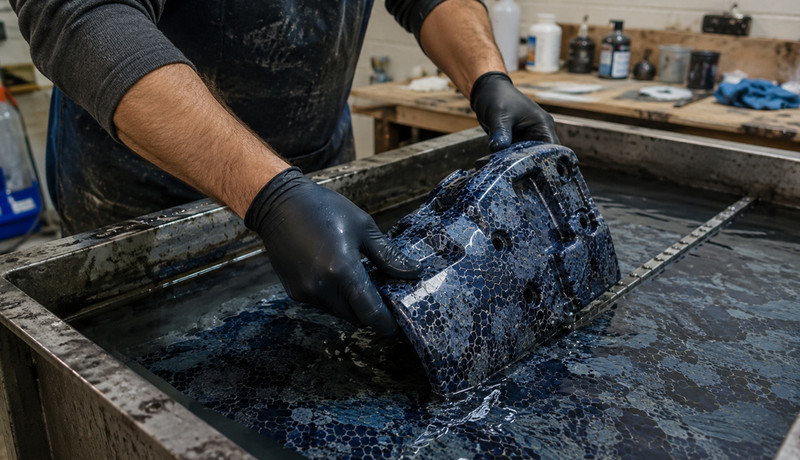
Hydro dipping transfers printed graphics through water onto a part, allowing the image to wrap around contours that are difficult or impossible for flat graphics methods to handle consistently.
In industrial applications, the biggest advantages tend to be:
- Full 3D coverage: wraps around curves, edges, recesses, and complex shapes
- Uniform appearance: fewer visible start/stop points compared to wraps and large decals
- Scalable customization: print what you need for each production run without stocking dozens of pre-printed patterns
- Brand control: logos, serial-style marks, and design variants can be printed on-demand
When printable hydrographic film beats decals
Decals are fast and cost-effective on flat or gently curved surfaces. They struggle when the part has:
- deep contours or channels
- tight radii and compound curves
- edges that create lift points
- texture that traps air and causes silvering
Hydrographics typically win when:
- You need graphics to flow cleanly across edges and recesses
- You want fewer visible seams and lift points
- You need a more “integrated” look under clear coat
Common industrial examples: molded housings, contoured control panels, protective covers, tool casings, and parts with ribs or ergonomic grips.
When printable hydrographic film beats wraps
Wrap vinyl is excellent for large flat areas and vehicles. But industrial parts often feature complex geometry and small surface transitions that are difficult to wrap without relief cuts, stretching, or seams.
Wraps struggle most with:
- compound curves
- tight inside corners
- recessed areas and vents
- small parts where handling is slow and seam placement is obvious
Hydrographics typically win when:
- You need consistent coverage on complex 3D shapes
- You want to avoid relief cuts and seam lines
- You need repeatable throughput on contoured parts
Common industrial examples: hand tools, power tool housings, protective guards, safety covers, specialty handles, and molded assemblies.
When printable hydrographic film beats UV printing
UV printing can be great for flat goods and some gently contoured items. But on complex geometry, UV printing may require special jigs, multiple passes, or multiple orientations, and it can still leave unprinted shadow zones.
UV printing is limited by:
- line-of-sight printing (shadowing around curves and recesses)
- fixture complexity for irregular parts
- edge coverage challenges
- multi-step setups for printing multiple sides
Hydrographics typically win when:
- You need full-wrap graphics without shadowing
- The part geometry would require multiple UV setups
- You want a uniform look across edges and contours
Common industrial examples: housings with ribs and recesses, ergonomic grips, components with multiple faces, and parts with deep contours.
Industrial use cases where printable film shines
1) Branded housings and enclosures
Printable hydrographic film is ideal for molded plastic or coated metal housings where you want a durable, uniform graphic finish across complex shape transitions.
2) Tools and equipment components
Hydrographics can deliver consistent coverage on hand tools, power tool housings, guards, and accessories where wraps and decals struggle with curvature and grip textures.
3) Consumer-facing industrial products
Products sold at retail often need a premium “finished” look. Hydrographics can provide an integrated appearance under clear coat, improving perceived value.
4) Short-run SKU variation
If you have multiple variants (colors, branding, regional labels, limited editions), printing film on-demand avoids stocking many pre-printed options and reduces slow-moving inventory.
5) Complex parts that require edge-to-edge aesthetics
When the customer expects the pattern to flow across edges and recesses without visible start/stop points, hydrographics can be the most practical method.
When decals, wraps, or UV printing are the better choice
Hydrographics isn’t always the best fit. Other methods may win when:
- The part is flat and needs fast labeling (decals)
- You need large-format graphics with minimal handling (wraps)
- You are decorating mostly flat items with high-resolution spot graphics (UV)
- The part cannot be dipped due to size, masking constraints, or process limitations
Many industrial workflows use a hybrid approach: hydrographics for complex, high-visibility parts and decals/UV for simple labels and flat components.
How to decide for your operation
Ask these questions:
- Geometry: Is the part complex enough that flat graphics will seam, lift, or shadow?
- Coverage: Do you need edge-to-edge wrap coverage or just a label/mark?
- Volume and variants: Are you running many short variants that benefit from on-demand printing?
- Finish expectations: Does the customer expect a premium, integrated look under clear coat?
If the part is contoured, customer-facing, and you need consistent wrap coverage, printable hydrographic film is often the simplest route to a premium finish.
Final tip: printable film gives you flexibility without stocking patterns
For industrial teams, one of the biggest benefits of printable hydrographic film is control. You can print your own patterns, branding, and variants on-demand, then apply them across complex 3D geometry more cleanly than decals, wraps, or UV printing.
Hydrokon Water Transfer Film is designed to support that flexibility by giving decorators and production teams a printable film option for custom hydrographic applications. Instead of relying only on stocked patterns or trying to force decals, wraps, or UV printing onto parts that are not well suited for those methods, Hydrokon helps you create custom graphics for the parts, brands, and production runs in front of you.
If you are evaluating printable hydrographics for your operation, Hydrokon Water Transfer Film can help you test new patterns, support short-run customization, and improve graphic coverage on complex parts.
Want help evaluating a part? Contact Hydrokon and share the material, part geometry, desired coverage, and production volume. We can help you determine whether Hydrokon Water Transfer Film is the right fit for your process.